
DEFENSIBLE ANALYTICS / THE EXECUTIVE QUESTION
Your systems produced the answer. Can you defend the decision?

Most organizations can explain how analytics or AI produced a result. The harder question is whether the information supporting a material business decision was appropriate for that decision—and whether its use was authorized.


A decision can be technically correct – and still be unsupported for its stated use.
An executive report or AI recommendation may look credible even when the evidence behind it is not ready for the stated use. A “customer” count, for example, may count households, accounts, or individual people. Each calculation may be mathematically correct, but each answers a different business question. Executives need to know which definition was approved for the stated use. The information may also be outdated, or the evidence may have been used without approval because someone assumed it was authorized. An assumption is not authorization.
THE DECISION TEST
One number. Two definitions. A consequential choice.
An executive report states 42,318 active customers. Finance defines a customer as an active account; Operations defines a customer as an active household. Both calculations may be technically valid, but they measure different populations and may support different decisions.
Before relying on the number, the executive must be able to determine which definition of customer was used, what qualified a customer as active, which customers were included or excluded, and the effective date of the count. The executive must also know whether that population was the one approved for the decision being made.
The question is not simply whether 42,318 was calculated correctly. It is whether the calculation counted the population defined and approved for the stated decision.
Illustrative scenario; not an actual customer metric.
Before the number is used
The risk is not the existence of two definitions. It is material reliance on the assumed customer (Identity) without an evidenced choice between them (the meaning).
THE DACS RESPONSE
Make important decisions easier to stand behind.
Before your organization acts on a report, forecast, or AI recommendation, DACS helps establish whether the information is appropriate for that decision, whether its use is authorized, and what uncertainties remain.
It makes clear what can move forward, what requires caution, and what must wait – while documenting the evidence needed to explain and defend the decision later.
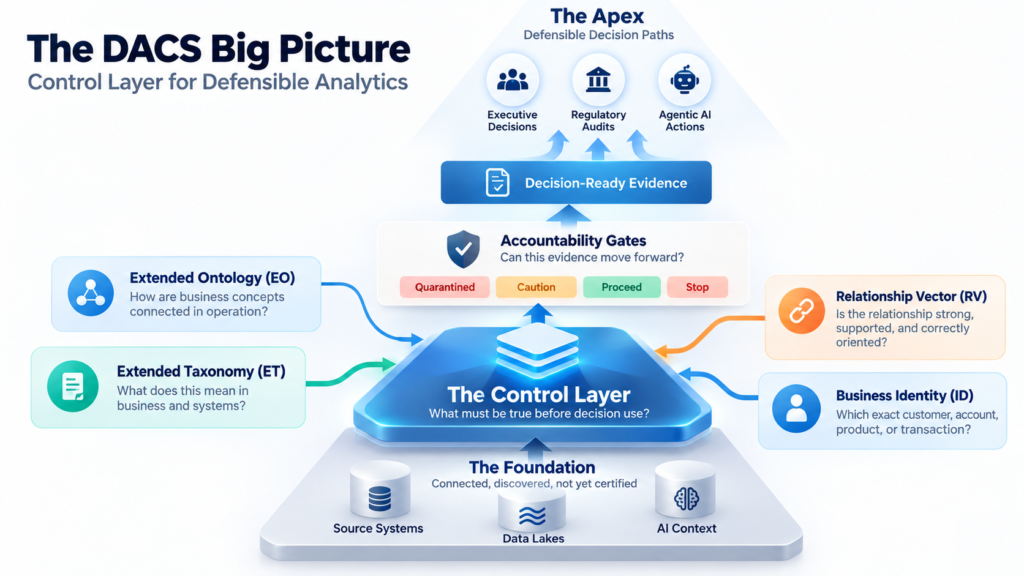
DACS Big Picture. This overview is illustrative. Only a recorded Proceed state or explicitly authorized constrained Caution permits material use within its scope; Stop and Quarantined do not.
A QUESTION FOR YOUR LEADERSHIP TEAM
If this decision were challenged tomorrow, what could we prove today?
Not what we think happened. Not what the systems are capable of showing now. What evidence, controls, authority and conditions were actually in force when the decision was made?
AN EVIDENCE-BASED START
Start with one decision – this is not an enterprise transformation exercise.
A DACS First Look begins with a bounded Day One exercise. It designed to make the decision scope, available evidence, gaps, constraints and next step visible. Continue the exercise, day by day, only when each day’s findings justify the next. The exercise is intended to continue for no more than five business days.
What Day One should reveal
THE EXECUTIVE PUBLICATION
A brief worth reading. A question worth sharing.
The Executive Brief sets out the accountability gap, the practical cost of unresolved evidence and a bounded way to test one important decision path. Read it for free; no registration required.
Continue the examination: Executive Overview · Manifesto · Specification