
Kadence TEST
DACS EXECUTIVE BRIEF
Your systems produced the answer. Can you defend the decision?
Why Defensible Analytics Requires More Than Data, AI, and Governance
Most organizations can explain how data, analytics, AI, and automated processes contributed to a major business decision. The harder question is whether the information supporting that decision was appropriate, sufficiently verified, and authorized for that specific use.
If the organization cannot demonstrate that basis, it may face repeated reconciliation, costly investigations, unresolved exceptions, delayed AI initiatives, and decisions that are difficult to defend when challenged.
THE EXECUTIVE OPPORTUNITY
DACS offers a practical way to identify these gaps before they create larger consequences – without asking leadership to replace its technology or commit to an enterprise-wide program.
THE LIMITED REQUEST
Consider authorizing Day One of a DACS First Look for one important decision. Require useful findings at the end of that day. Continue only when the evidence supports further work, with a maximum of five business days.
For executive sponsor review | Editorial revision for DVA approval
Founding authors and committee leads: Daniel Linstedt, CEO, and Cindi Meyersohn, Chief Operating Officer, DataVaultAlliance Holdings LLC.
Official publications: https://dacs.datavaultalliance.com/documents/executive-brief
DataVaultAlliance maintains the authoritative DACS Specification. Verify the current approved version before relying on a redistributed copy.
1 The leadership question
A report can be numerically accurate, an AI recommendation can look reasonable, and an automated process can run exactly as designed. Yet none of those outcomes alone establishes that the supporting information was suitable for the business decision or that its use was authorized.
Consider a familiar example. Finance counts active billable accounts; Operations counts households receiving service. Both counts may be accurate for their respective purposes. If leadership approves an investment using a customer-growth measure, which definition was appropriate for that decision – and could the organization demonstrate why?
This is the DACS problem. It is not a claim that the reporting system failed. It is the possibility that information was relied upon for a consequential decision without an explicit, testable, and reconstructable basis for that use.
WHAT AN EXECUTIVE SHOULD BE ABLE TO ASK
What information did we use? What did it mean? Was it appropriate at that time? Who had authority to approve its use? What was uncertain or restricted? Could we demonstrate those answers months later?
2 Why this matters to enterprise performance
The business case is not governance for its own sake. It is the cost and risk exposure of resolving questions after decisions have already been made – often across departments and under pressure from executives, auditors, customers, regulators, or other stakeholders.
Repeated reconciliation. Different teams spend time re-explaining customer, revenue, risk, or operational measures instead of acting on addressing them.
Delayed decisions and AI scale. Promising analytics and AI initiatives can be held back when no one can substantiate the definitions, assumptions, information, or authority behind intended actions.
Audit and management effort. Review teams reconstruct past decisions from scattered records, system logs, approvals, and personal recollections without a repeatable, proven approach for capturing, tracing, and mapping those artifacts.
Hidden risk and rework. Incorrectly combined customer records, stale business conditions, unclear responsibilities, and untested assumptions can remain invisible until the decision is questioned.
The First Look can expose cost drivers and establish a baseline. Actual savings or reductions in risk must be demonstrated through subsequent corrective action and measurement; DACS does not guarantee either but it can capture those aspects for traceability.
3 What DACS changes for management
DACS – the Defensible Analytics Control Specification – is a vendor-neutral, implementation-neutral set of testable requirements for information used in a defined business decision. It helps the organization establish whether the information and conditions supporting that decision met the applicable requirements for that particular use.
DACS gives leadership a clearer view of what is substantiated, what is uncertain, who is responsible, what use is allowed, and what needs to be addressed before broader reliance. The organization retains its existing decision-making authority; DACS defines what needs to be evaluated and recorded.
Before important use. Applicable requirements are assessed against supporting information and approved business conditions. Where an actual evaluation supports it, an Accountability Gate records whether a use can: proceed, proceed only with enforceable limitations, must stop, or whether candidate information must be held for review.
After the decision. Supporting records preserve what information and rules applied, the control findings, the responsible authority, exceptions, and conditions at the relevant time. They make the decision basis reviewable without assuming that an exact rerun of an old model or system is possible.
THE BUSINESS DISTINCTION
Having data, an AI output, or a completed approval is not by itself proof that the information was appropriate and authorized for the decision being made.
4 Where weaknesses can hide
The first evaluation should concentrate on whichever questions actually matter to the selected business decision rather than every imaginable requirement across the enterprise.
Business definitions. Do financial, sales, and operational measures mean what leadership thinks they mean for this use?
The correct customer or account. Are we evaluating the intended individuals, companies, products, transactions, or other entities?
Assumptions and connections. Are the relationships and conclusions used in the analysis justified rather than merely plausible?
Timing and relevance. Were the information, policies, definitions, and business conditions applicable when the organization acted?
Authorization and AI behavior. Who authorized the particular use? When AI was involved, were its inputs, recommended actions, and restrictions appropriate?
Records that survive challenge. Could an independent reviewer inspect the relevant information and evaluation results without relying on the original team’s memory?
5 What existing investments contribute – and what remains
Data catalogs help people find information. Data-quality processes test values. Lineage systems show where data moved. Semantic layers support consistent measures. AI platforms generate recommendations or carry out actions. Logs show what a system did. Governance teams establish policies and accountability.
Each is valuable. None alone necessarily demonstrates that a particular decision was justified in using particular information under the conditions that existed at the time. DACS helps connect the available capabilities and their recorded evidence to that specific question.
NO PLATFORM REPLACEMENT
A DACS First Look can use existing reports, governance materials, approvals, logs, and manual evidence capture. It does not require a new vendor, a physical data model, an enterprise-wide ontology, or migration of the technology stack.
Where relevant, vendors may be asked to demonstrate whether their products can produce, retain, exchange, or enforce the required evidence. That is a request for capabilities tied to the selected decision – not a vendor certification claim.
6 A decision you can actually manage
DACS distinguishes the results of individual checks from the decision about whether information may be used. Applicable checks are recorded as Pass, Fail, or Not Applicable, with reasons and supporting evidence. Separately, an Accountability Gate may establish the following readiness states:
|
Gate outcome |
What leadership needs to know |
|---|---|
|
Proceed |
The applicable Gate requirements are satisfied. The recorded use may proceed while its stated conditions remain valid. |
|
Caution |
A specifically authorized use may proceed only within recorded, enforceable limits. Failed controls remain failed; caution does not turn fails into passes. |
|
Stop |
A blocking condition prevents the affected business use. Correct the problem and reassess before proceeding. |
|
Quarantined |
Candidate or unresolved information is preserved for exploration, review, or correction, but cannot support the material decision. |
The presence of a named accountability control (Gate) state does not mean a Gate Outcome has been earned. It must be supported by the required assessment, evidence, authority, and recorded decision. A human approval alone cannot override a mandatory DACS failure.
7 What the leadership scorecard tells you
An executive should not need to read technical control logs to understand the outcome. The DACS Defensibility Scorecard reports which applicable requirements passed, failed, or did not apply; which accountability controls (Gate) states were established; which issues remain open; and what action should follow.
It does not report an overall percentage, grade, probability of defensibility, or weighted “trust score.” Passing most checks is insufficient if a mandatory requirement has failed. Counts explain findings; they do not independently establish DACS conformance or permission to proceed.
The readiness snapshot answers: What can we substantiate today?
The scorecard answers: Which requirements were met, which were not, and where are the constraints?
The evidence record answers: Could we later demonstrate how the use was assessed and authorized?
The corrective-action list answers: What must be fixed, verified again, or held back?
8 The DACS First Look: start with one day
The proposed starting point is deliberately limited to: one material business decision, the people responsible for it, available supporting information, and the single Day One exercise. The goal is an actionable management finding before any deeper commitment is agreed to.
DAY ONE DELIVERABLE
Identify the decision and its boundaries; inspect available records; document what is supported, missing, or uncertain; record applicable initial results and any accountability control (Gate) outcome actually supported; and recommend whether to stop, correct issues independently, or continue.
Every additional day requires a useful prior-day result and a fresh stop, remediate, or continue decision. The standard First Look ends after no more than five business days. Stopping early can still mean a successful outcome.
|
If continued |
Business question and potential activity |
|---|---|
|
Day 2 |
Are the measures and entities defined correctly for this decision? Evaluate relevant definitions, identity, source, and authority requirements. |
|
Day 3 |
Are assumptions, business conditions, relationships, approvals, and AI use appropriate? Evaluate only the applicable requirements. |
|
Day 4 |
Can important issues be corrected and reassessed within the agreed scope? Preserve unresolved conditions explicitly. |
|
Day 5 |
What has been established, what remains restricted or unresolved, and what should management do next? Complete applicable records and recommendation. |
These are possible activities, not automatically authorized work or mandatory stages. Technical methods, assessment forms, and task assignments belong in the First Look Pilot Kit.
9 What the organization receives
The assessment is useful when it makes the business situation clearer, even when it reveals missing information or a reason to stop. Depending on the work performed and evidence established, leadership can receive:
DACS Readiness Snapshot. One concise view of the chosen decision, its supporting information, established readiness, gaps, and uncertainty.
Defensibility Scorecard. Inspectable Pass, Fail, and Not Applicable findings, with actual accountability control (Gate) states and conformance determination only where supported.
Structured evidence package. References to supporting records, authority, time-valid information, constraints, and assessment outcomes.
Remediation backlog. Significant unresolved issues, the action needed to resolve them, and retest expectations.
Next-step recommendation. A reasoned decision to stop, correct issues, evaluate another bounded decision, or separately consider a broader program.
At the first day, findings may be preliminary and incomplete. The final scope and completeness of each deliverable depends on the evaluation actually performed.
10 What to measure, and when
The First Look may establish the baseline for assessing whether this approach improves management outcomes. Financial or operating benefits should be claimed only when they are subsequently demonstrated.
Time to explain a challenged decision. How much effort and elapsed time does it take to retrieve and substantiate the decision basis?
Recurring definition disputes. Are conflicting business measures and their causes being resolved rather than repeatedly reconciled?
Unresolved exceptions. How many material gaps, constraints, AI-related exceptions, or blocked uses remain open?
Verified correction. Which problems were actually resolved and retested, rather than simply marked complete?
Reuse within approved boundaries. Which definitions, verified relationships, or evaluation records can be appropriately reused for related decisions?
The companion Defensibility Scorecard and Measurement Guide governs definitions and measurement methods; the brief does not imply a composite readiness percentage.
11 Expansion is a separate management decision
The First Look does not authorize a DACS enterprise program. If one decision produces a useful, repeatable evaluation pattern, leadership may later choose to apply it to related reports, AI-assisted decisions, or operational processes. Broader adoption should proceed only where its value, ownership, and requirements are justified.
Start small. Choose one consequential decision, establish which requirements matter, test the supporting information, and document the findings.
Expand selectively. Reuse proven checks and records only when the new decision has its own appropriate scope, applicable requirements, and accountable authorities.
Retain governance accountability. Business leaders, risk and governance functions, and technical participants continue to own their responsibilities; DACS does not give decision authority to a tool or an assessor.
12 The executive decision and next action
An executive sponsor need not approve a transformation program or master the DACS Specification. The near-term decision is whether an important decision in the organization warrants a bounded, evidence-based review.
RECOMMENDED AUTHORIZATION
Authorize the Day One exercise of a DACS First Look for one material business decision. Name a business owner, a technical owner, and the relevant governance authority. Require a written Day One outcome covering the selected decision, available supporting information, established findings, uncertainty, constraints, and the recommended next step. Continue only when each preceding day justifies it, with five business days as the maximum duration.
Protect the scope. Do not make the initial review a platform replacement, enterprise-wide data-modeling exercise, vendor selection, or automatic multi-day commitment.
Interpret findings correctly. Blocked or constrained evidence is useful risk visibility – not a failed initiative. Where the controls cannot support reliance, do not represent the decision as DACS-conformant.
Close the loop. Use the results to decide whether to stop, correct issues, assess a different decision, or consider a separately approved expansion.
A short recommendation to share with the executive team
FOR MANAGEMENT DISCUSSION
Our organization relies on reports, analytics, and AI to make consequential decisions. We should determine whether we can demonstrate that the supporting information was appropriate, sufficiently verified, and authorized for one such decision. The DACS Executive Brief describes a focused Day One evaluation, with additional work only if the findings justify it. I recommend that we consider one bounded review before making any broader commitment.
Important boundaries
DACS does not guarantee a correct decision, eliminate risk, certify an entire organization, prove legal or regulatory compliance, or replace legal, risk, audit, and regulatory review. It defines requirements for evaluating and recording decision-specific evidence. DACS conformance requires every mandatory applicable control to be satisfied; an authorized exception cannot turn a Failed mandatory control into a Pass. Accountability Controls (Gate) readiness and organizational capability are distinct from conformance.
Appendix A | The DACS terminology behind the business language
Decision scope. The specific decision or use under evaluation, including relevant business boundaries, intended purpose, and what is excluded.
Core Decision-Scope Controls. The essential control requirements for the declared decision, its supporting evidence, its use conditions, and its ability to be reviewed later.
Extended Taxonomy Controls. Requirements establishing what business terms, categories, measures, and identifiers mean, with the relevant ownership and evidence.
Extended Ontology Controls. Requirements for verifying business relationships, their meaning and direction, constraints, and supporting evidence.
AI Context Contract Controls. Requirements addressing the information given to AI, permissible behavior, changing context, applicable restrictions, and recorded actions.
Semantic Contract. The documented, governed business agreement about applicable meaning, identity, relationships, rules, and permitted uses.
Accountability Gate. A controlled evaluation point that records the permissible next state – Proceed, Caution, Stop, or Quarantined – after applicable requirements are evaluated.
Conformance Record. The structured record of the decision scope, applicable controls, findings, supporting evidence, relevant authority, Gate result if established, time, and review conditions.
Decision Execution Trace. Where applicable, the structured account of an automated or AI-supported action, its inputs, context, tools, conditions, and resulting action.
Appendix B | Executive First Look checklist
Use this checklist when sponsoring Day One, reviewing interim findings, or considering a closeout recommendation. Recorded answers and supporting references are required where applicable; this checklist itself is not a conformance determination.
Which decision matters? State the business purpose, consequence, decision owner, intended use, and exclusions.
Who is responsible? Identify the business owner, technical owner, and relevant authority for the specific use.
What do we actually know? Inspect the available information, documented conditions, and unresolved issues.
What passed or failed? Require supported Pass, Fail, or Not Applicable findings; any conformance determination must follow the applicable controls.
What use is allowed now? Require the actual recorded accountability control (Gate) readiness where assessed including its enforceable conditions, blockers, and review triggers.
Could we explain it later? Preserve evidence references, relevant versions, time, responsibility, and review conditions.
Should we continue? Record whether to stop, correct independently, or authorize the next bounded day based on evidence.
Appendix C | Technical reference: the DACS Big Picture
This illustration is reproduced from the supplied Executive Brief. It shows the technical control architecture behind the management outcomes explained in the preceding sections. The diagram is optional detail for the executive reader.
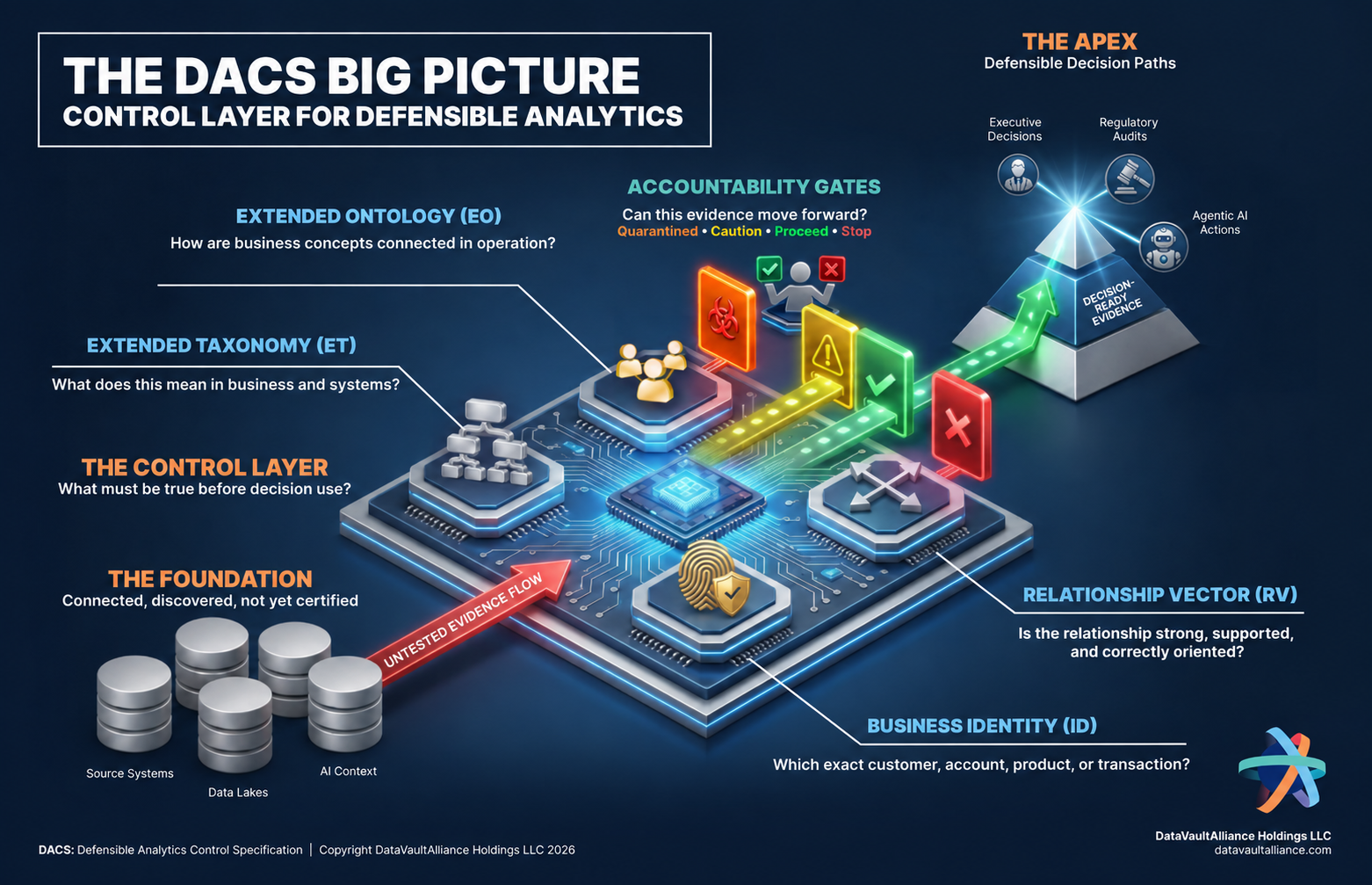
Technical image: data and AI sources; the DACS evidence layer; control profiles; Accountability Gates; recorded findings; and consequential business decisions.
EXECUTIVE INTERPRETATION
Existing systems produce information. DACS sets requirements for checking whether the information is suitable and authorized for a particular decision, records any limits on its use, and retains supporting evidence for later review.
Copyright (c) 2026 DataVaultAlliance Holdings LLC. All rights reserved. This executive-language revision is proposed for editorial approval and does not supersede any authoritative DACS publication.